
Singapore with Tat Haur Lee
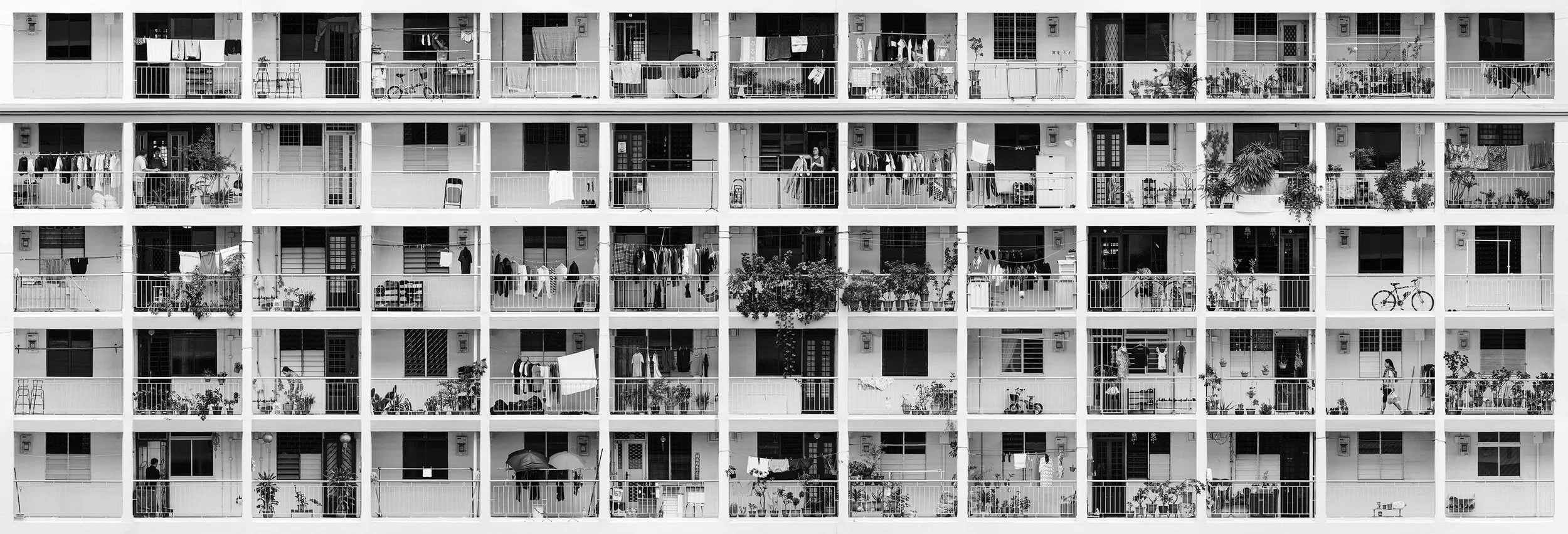
In this episode, we turn our attention to Singapore—a city often described through the language of efficiency, optimisation, and control. A compact island state at the crossroads of trade routes and cultures, Singapore is frequently held up as a model of urban governance: clean, dense, green, orderly, and relentlessly planned. Yet beneath this carefully calibrated surface lies a far more intricate everyday urbanism.
Corridors become living rooms. Void decks host weddings and wakes. Kopitiams anchor daily rituals across generations. In a city where nearly 80 percent of residents live in public housing, the spaces between buildings carry as much meaning as the buildings themselves. We are joined by Tat Haur Lee to explore how this officially ordered city is also a deeply improvised one—shaped as much by the habits, adaptations, and social life of its residents as by the master plans of its planners.
The conversation explores what Singapore reveals about the limits and possibilities of top-down urban design, and what it means to build social cohesion through architecture and public space. Singapore is a city that has engineered much of its own reality—and yet the most compelling aspects of its urbanism are often those that exceed or escape the plan entirely.
SUP is hosted by Ian Nazareth, Graham Crist and Christine Phillips.
This podcast is produced with support from the Alastair Swayn Foundation and the RMIT University School of Architecture & Urban Design.
We acknowledge the people of the Woi wurrung and Boon wurrung language groups on whose unceded Country we are recording this podcast.
People + Teams
Associate professor of Architecture and Sustainable Design at the Singapore University of Technology and Design.
Leads the Meta Design lab.
Atelier Bow Wow / Yoshiharu Tsukamato
Tokyo-based architecture firm
Global Case Studies
Research institute at the Singapore University of Technology and Design focusing on issues surrounding urbanisation and cities
Singapore's Housing and Development board providing dwellings for 80% of residents
open air food court and market
a famous Hawker Centre in central Singapore
Theories + Planning
United Nations Ring City Plan (Otto Koengsberger, 1963)
Concept to manage urban sprawl in Singapore
Garden City Concept (Ebenezer Howard, 1902)
a British concept about countryside living with the benefits of city life
Third Spaces (Ray Oldenberg, 1989)
informal, neutral public spaces that are essential for community interaction
Tat Haur Lee has also been researching this concept.
Slab Block Model (HBD, 1960s/70s)
long, linear housing models with a common corridor developed in Singapore
open, sheltered ground floor spaces in Singapore residential blocks
coffee shops found below public housing blocks
Piloti’s (Le Corbusier, 1920s)
columns/pillars that raise a building and create a sheltered space underneath
Nolli Map of Rome (Giambattista Nolli, 1748)
Famed map of ancient Rome after researching and surveying
Literature + Critical Perspectives
Of Hospitality (Jacques Derrida, 2000)
Garden Cities of To-Morrow (Ebenezer Howard, 1898)
The Great Good Place (Ray Oldenberg, 1989)
Five Points of New Architecture (Le Corbusier, 1927)
See Also
Slack Spaces (Rory Hyde, 2023)
What Would a Non-Sexist City Be Like? (Dolores Hayden, 1980)
The Death and Life of Great American Cities (Jane Jacobs, 1961)