
Hyper Cities with Winy Maas
This episode of the Super Urban Podcast ventures into one of the most expansive propositions in contemporary architectural thinking: that everything is urbanism. Drawing from Winy Maas's 2019 guest editorship of Domus, the conversation explores what it means when the city is no longer a bounded object but a total condition — absorbing climate systems, data networks, food production, finance, and human behaviour into a single, planetary field of design. The discussion moves through the long arc of MVRDV's data-driven and speculative work — from Metacity/Datatown and Pig City to FARMAX and KM3 — tracing how architecture shifted from describing objects to modelling systems, using data not as neutral optimisation but as a critical tool to expose contradictions and test urban limits.
The conversation also tackles the concept of Biotopia — a future where buildings operate as living ecosystems — alongside the transformation of infrastructure into culture, as seen in projects like Depot Boijmans Van Beuningen. Threading through each of these themes is a consistent tension: does the expansion of architecture's scope into ecology, biology, economics, and atmosphere empower the discipline or risk dissolving its capacity to act and resist? The episode closes with a preview of Sky City, a project developed through The Why Factory currently being co-taught as a studio at RMIT University in Melbourne, which asks what urbanism becomes when the sky itself is treated as a designed, contested, and algorithmically governed urban layer.
Winy Maas is a Dutch architect, urbanist, and co-founding partner of Rotterdam-based MVRDV, established in 1993 alongside Jacob van Rijs and Nathalie de Vries. His leadership has driven many of the office's award-winning projects, including Rotterdam's Markthal, the Tianjin Binhai Library, and Depot Boijmans Van Beuningen — the first publicly accessible art depot in the world. He is also the founder of The Why Factory, a research laboratory dedicated to speculative urban futures, and holds professorships at both MIT and TU Delft.
SUP is hosted by Ian Nazareth, Graham Crist and Christine Phillips.
This podcast is produced with support from the Alastair Swayn Foundation and the RMIT University School of Architecture & Urban Design.
We acknowledge the people of the Woi wurrung and Boon wurrung language groups on whose unceded Country we are recording this podcast.
People + Teams
The Why Factory – global think tank and research institute at MVRDV, lead by Winy Maas
MVRDV NEXT – MVRDV’s coding department
Global Case Studies
Tianjin Binhai Library in China (MVRDV, 2014-17)
Villa VPRO in Hilversum, Netherlands (MVRDV, 1993-97)
Sky Valley in Chengdu, China (Speculative project by MVRDV, 2020)
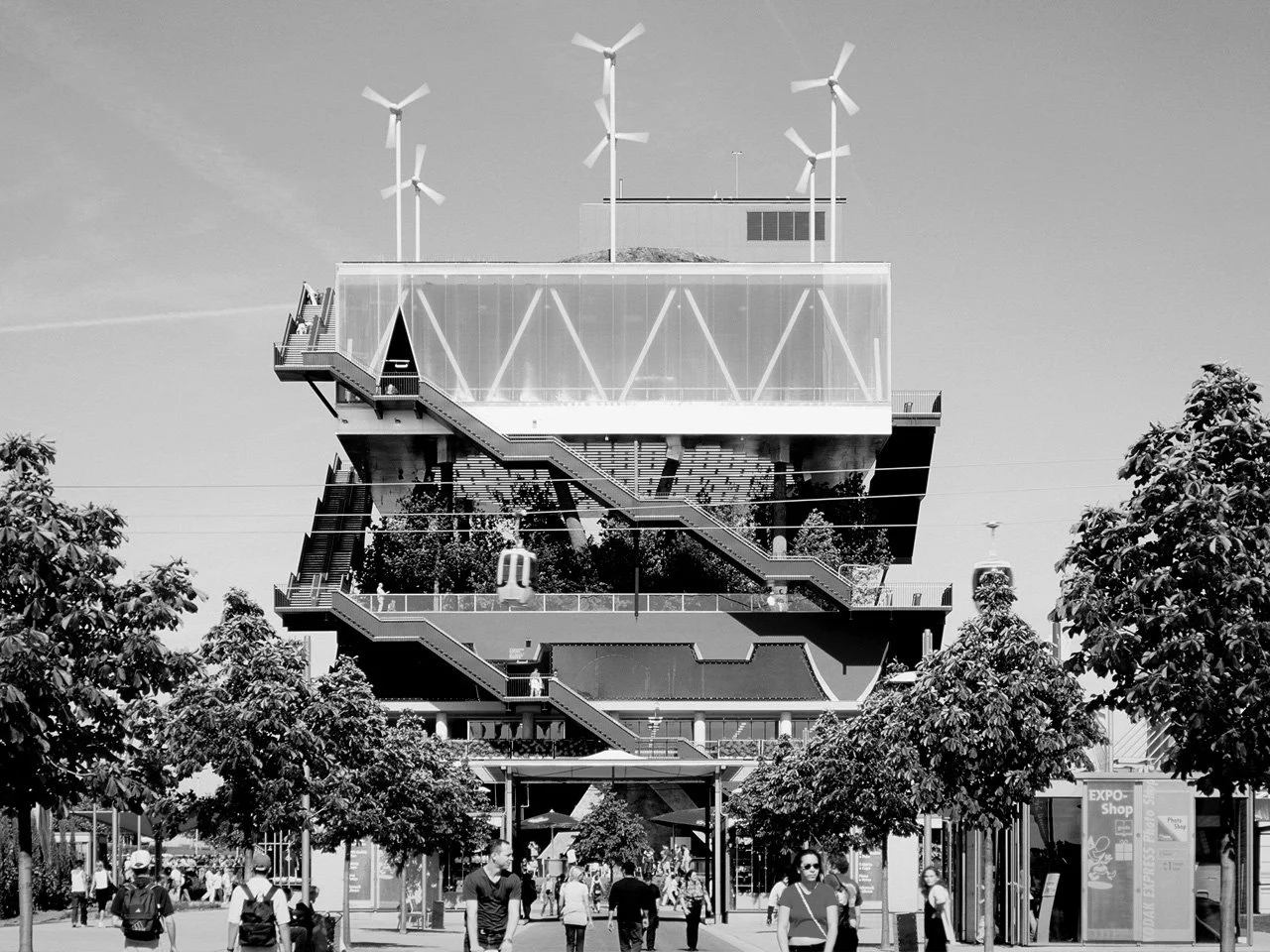
Expo 2000 Pavilion in Hannover, Germany (MVRDV, 1997-2000)
Seoullo 7017 Sky Garden in Seoul, South Korea (MVRDV, 2015-17)
Mirador in Sanchinarro, Spain (MVRDV, 2001-5)
Sky City (Speculative project by The Why Factory, 2019)
Centre for the Arts in Chengdu, China (MVRDV, 2007)
Mainau Island Masterplan in Konstanz, Germany (MVRDV, 2019-20)
Markthal in Rotterdam (MVRDV, 2004-2014)
Vertical Village (Speculative project by The Why Factory, 2014)
PoroCity (Speculative project by The Why Factory, 2018)
Theories + Planning
Biotopia – a radical architectural theory that reimagines human settlements as self-sustaining, living ecosystems
Everything and every(body) is urbanism – because human impact touches every corner of the globe, all scales—from an individual chair to entire planets—must be designed and understood through the lens of urban planning
Literature + Critical Perspectives
Winy Maas work as a guest editor for DOMUS, 2019
Everything is Urbanism article (Winy Maas for DOMUS, 2019)
Metacity/Data Town (Winy Maas, 1999)
Five Minutes City: Architecture and (Im)mobility (Winy Maas, 2003)
Skycar City (Winy Maas, 2006)
FARMAX: Excursions on Density (MVRDV, 2013)
KM3: Excursions on Capacity (MVRDV, 2005)
The Green Dream (The Why Factory, 2010)
(W)ego: Dream Homes in Density (The Why Factory, 2022)
See Also
Winy Maas lecture at RMIT, 2026