
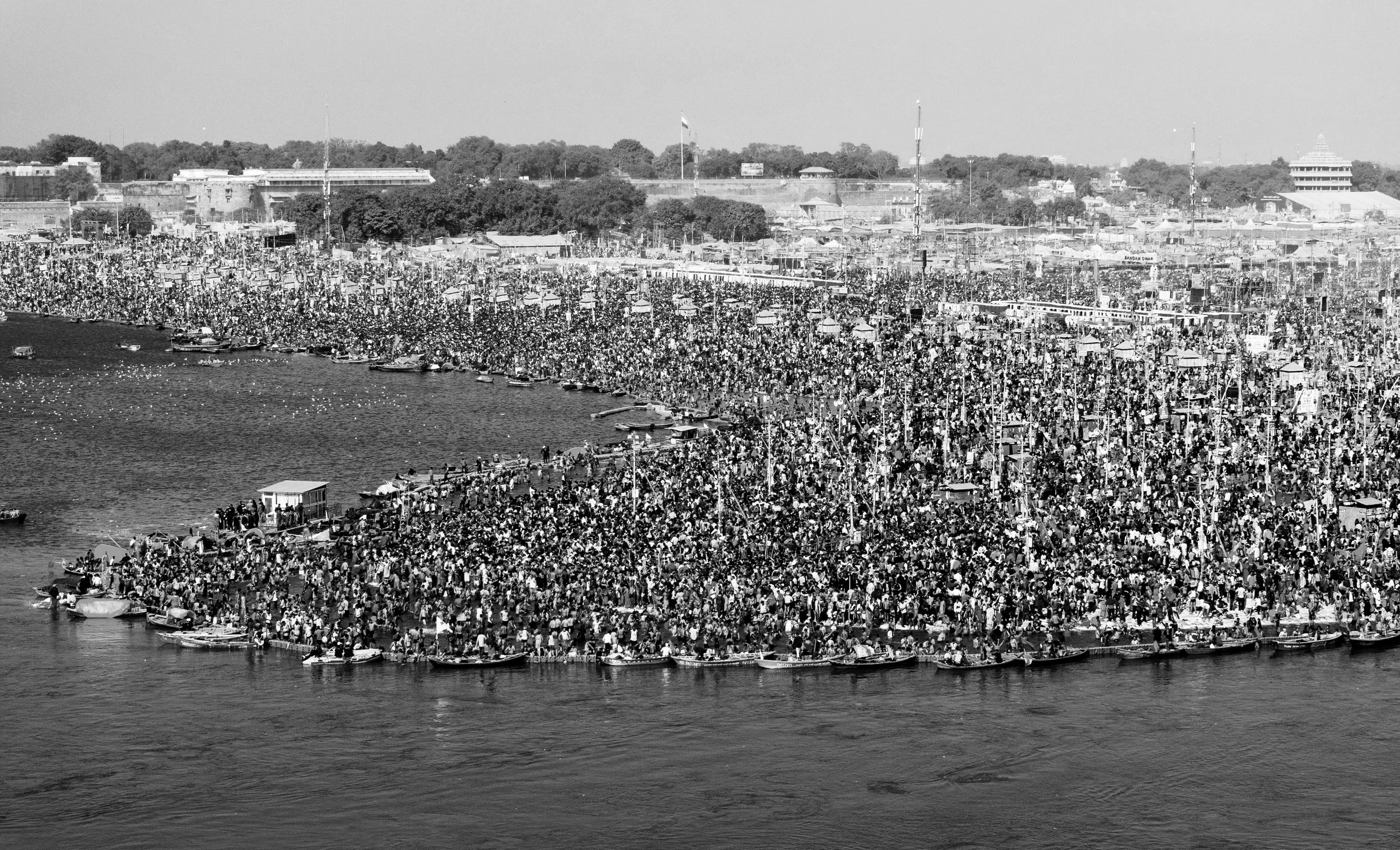
Kumbh Mela with Vaishnavi Laddha
In this episode, we speak with Vaishnavi Laddha about the Kumbh Mela—the world's largest experiment in ephemeral urbanism. Occurring every 12 years, it is a religious pilgrimage that manifests as a mega 'pop-up' city on the floodplains of India's sacred rivers, driven by religious mythology and collective devotion. With over 80 million visitors, the city emerges across 30 square kilometres of sandbanks, equipped with housing, temples, clinics, electricity, sanitation, and even governance structures—and then vanishes, leaving almost no trace.
What does this extraordinary event reveal about the nature of cities? The Kumbh Mela challenges many of our assumptions about permanence, infrastructure, and planning. It is a city that is simultaneously ancient in its origins and radically temporary in its form—a place where millions of people live, worship, and move through space with remarkable efficiency, despite the scale and intensity of the gathering.
Vaishnavi Laddha is an urban designer and graduate of the Master of Urban Design program at RMIT, currently working as a Junior Urban Designer at Dewan Architects and Engineers in Dubai. Her research brings a rigorous design lens to the question of ephemeral urbanism—and invites us to consider what lessons the Kumbh Mela might hold for the way we plan, design, and inhabit permanent cities.
SUP is hosted by Ian Nazareth, Graham Crist and Christine Phillips.
This podcast is produced with support from the Alastair Swayn Foundation and the RMIT University School of Architecture & Urban Design.
We acknowledge the people of the Woi wurrung and Boon wurrung language groups on whose unceded Country we are recording this podcast.
Show Notes
People + Teams
Global Case Studies
Theories + Planning
Pournami and Amavasya – phases of the moon with spiritual significance attached
Literature + Critical Perspectives
Kumbh Mela: Mapping the Ephemeral Megacity (Rahul Mehrotra, 2015)