
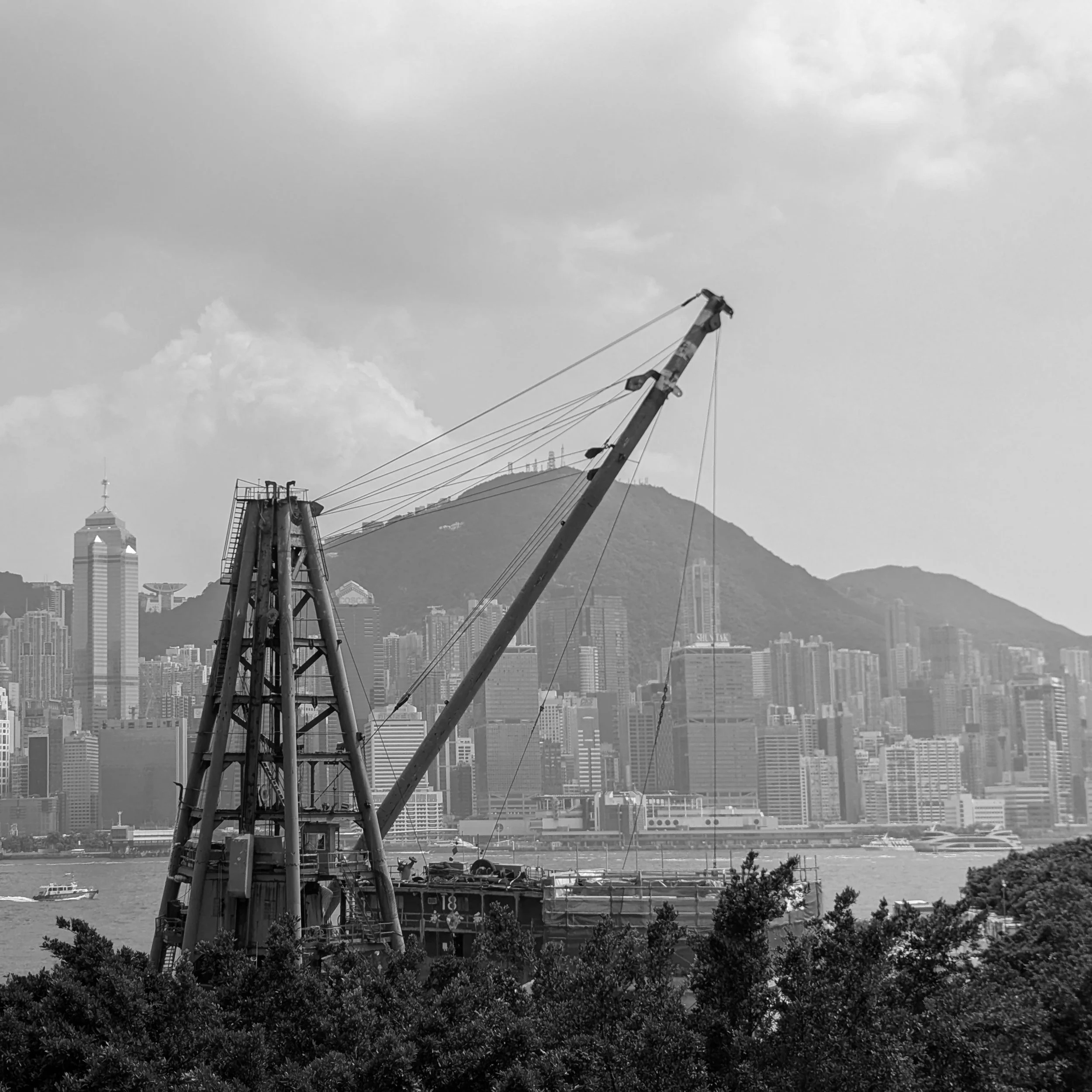
Hong Kong with Betty Ng
Hong Kong is a city drawn in section—stacked, stepped, suspended. A culture of building that has learned to fold terrain and threshold into one continuous surface. Architecture here is not a discrete object but a system of adjacencies: markets pressed beneath housing blocks, temples nested into retaining walls, gardens hovering above malls. It is a vertical choreography, where the street has been lifted, buried, replicated, and rerouted. Its history plays out as a sequence of layers and ruptured chronologies—a British colonial outpost and financial port city whose civic and spatial rituals persist through abrupt political and material shifts.
In this episode, we speak with Betty Ng—an architect who studied at both Harvard and Cornell, worked at renowned firms including OMA and Herzog & de Meuron, and is the founder of COLLECTIVE, an international practice with offices in London, Madrid, and Hong Kong. The conversation explores how architecture can operate as cultural infrastructure, supporting fragile economies, public life, and creative expression in a city of extraordinary density and nuance.
Situated on the southern rim of the Pearl River Delta—one of the most intensely urbanised geographies on earth—Hong Kong remains an anomaly. Its design culture resists the smoothness of the region's emerging megacities; it is textured, improvised, and deeply local even as it performs on a global stage. Yet this unique urban literacy is now under pressure from the slow erasure of civic space, the standardisation of planning codes, and the soft violence of homogenised aesthetics. Is there still a culture capable of inhabiting the slippages—between east and west, past and future, resistance and assimilation?
SUP is hosted by Ian Nazareth, Graham Crist and Christine Phillips.
This podcast is produced with support from the Alastair Swayn Foundation and the RMIT University School of Architecture & Urban Design.
Show Notes and References
Thought Pieces & Essays
Projects + Platforms
Ideas & Theories
Transit oriented development - High speed train Infrastructure that connects mainland China and Hong Kong
Dependency on Mechanical systems
The resilience towards cultural sector in Hong Kong
Lack of open competition for Architectural projects
Additional Reading
Stay connected